In pipeline engineering, mechanical manufacturing or fluid‑transport projects, proper steel pipe dimension selection is the first step that determines both cost and safety. Many buyers only focus on Nominal Diameter (DN), while overlooking the actual matching relationship among Outer Diameter (OD), Wall Thickness (WT), and Inner Diameter (ID), as well as the globally‑adopted NPS (Nominal Pipe Size) system. This is exactly where mistakes frequently occur during international procurement and specification selection.
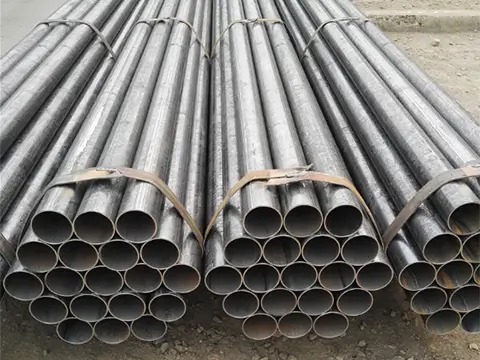
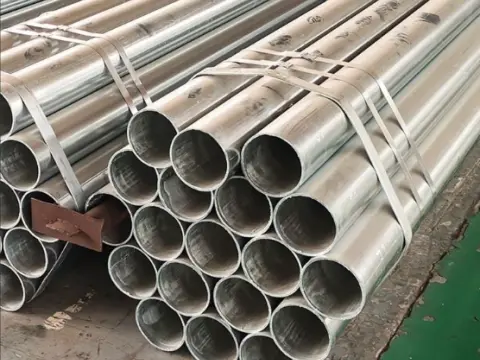
Today we bring you a dimension guide based on the globally‑recognized ASME B36.10M standard. It clearly explains the relationships among commonly‑specified NPS, outer diameter, wall thickness, and inner diameter.
1. Master These Globally‑Used Key Concepts
Before referring to any dimension table, please understand the basic formula and terminology below:
Inner Diameter (ID) = Outer Diameter (OD) − 2 × Wall Thickness (WT)
- NPS (Nominal Pipe Size): A North‑American‑originated global pipe‑size designation system, expressed in inches (e.g., NPS 2, NPS 4). Important: NPS value does NOT equal the actual outer diameter of the pipe. For example, NPS 4 stands for a nominal 4‑inch size, but its actual outer diameter is 4.5 inches (114.3 mm). Formed through historical evolution, this standard system means you cannot calculate outer diameter directly from the NPS figure.
- DN (Diameter Nominal): A nominal‑size designation adopted by ISO, expressed in millimetres. It has fixed corresponding relationships with NPS (e.g. NPS 2 = DN 50). For cross‑border projects, quoting both NPS and DN is the most rigorous practice.
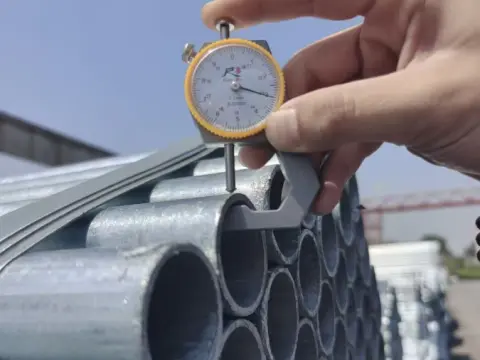
- Outer Diameter (OD): The outermost diameter of a steel pipe. For a given NPS, the outer diameter remains fixed and does not change with wall thickness. This is the critical dimension ensuring interchangeable fit with flanges, valves and other pipe fittings.
- Wall Thickness (WT): Thickness of the pipe wall. The most‑widely‑used global notation is the Schedule Number (e.g. Sch 40, Sch 80). Legacy designations including STD (Standard), XS (Extra‑Strong) and XXS (Double‑Extra‑Strong) also exist. Note that their equivalence to Schedule numbers is NOT valid across all sizes (see later sections).
- Inner Diameter (ID): Clear inner bore diameter of the pipe, which directly impacts media flow capacity and flow velocity.
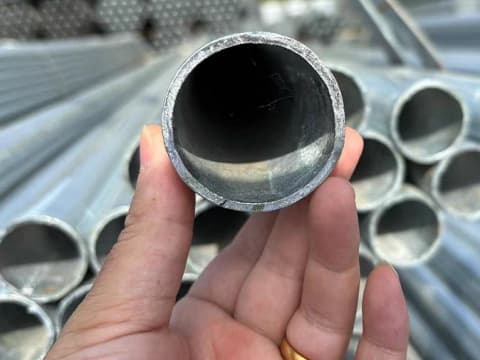
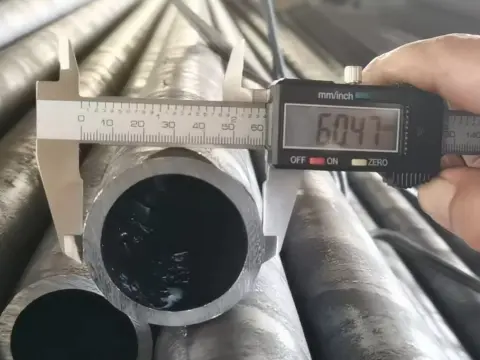
⚠️ Note: With fixed outer diameter, larger wall thickness (higher Schedule number) yields smaller inner diameter and higher pressure‑bearing capacity. Never judge the actual bore size merely by the “inch size” of a pipe.
2. Global‑Standard Dimension Comparison Table
Data in the table below follows ASME B36.10M, the core global standard for welded and seamless wrought steel pipe in carbon steel, alloy steel, and ferritic stainless‑steel grades. It lists NPS, DN, outer diameter (OD), together with wall‑thickness and inner‑diameter values for the two most‑common Schedule series: Sch 40 and Sch 80. Both inch (in) and millimetre (mm) units are provided for wall thickness.
| NPS | DN | OD (in / mm) | WT Sch 40 (in / mm) | ID Sch 40 (mm) | WT Sch 80 (in / mm) | ID (Sch 80) (mm) |
|---|---|---|---|---|---|---|
| 1/8″ | 6 | 0.405 / 10.3 | 0.068 / 1.73 | 6.84 | 0.095 / 2.41 | 5.48 |
| 1/4″ | 8 | 0.540 / 13.7 | 0.088 / 2.24 | 9.22 | 0.119 / 3.02 | 7.66 |
| 3/8″ | 10 | 0.675 / 17.1 | 0.091 / 2.31 | 12.48 | 0.126 / 3.20 | 10.70 |
| 1/2″ | 15 | 0.840 / 21.3 | 0.109 / 2.77 | 15.76 | 0.147 / 3.73 | 13.84 |
| 3/4″ | 20 | 1.050 / 26.7 | 0.113 / 2.87 | 20.96 | 0.154 / 3.91 | 18.88 |
| 1″ | 25 | 1.315 / 33.4 | 0.133 / 3.38 | 26.64 | 0.179 / 4.55 | 24.30 |
| 1‑1/4″ | 32 | 1.660 / 42.2 | 0.140 / 3.56 | 35.08 | 0.191 / 4.85 | 32.50 |
| 1‑1/2″ | 40 | 1.900 / 48.3 | 0.145 / 3.68 | 40.94 | 0.200 / 5.08 | 38.14 |
| 2″ | 50 | 2.375 / 60.3 | 0.154 / 3.91 | 52.48 | 0.218 / 5.54 | 49.22 |
| 2‑1/2″ | 65 | 2.875 / 73.0 | 0.203 / 5.16 | 62.68 | 0.276 / 7.01 | 58.98 |
| 3″ | 80 | 3.500 / 88.9 | 0.216 / 5.49 | 77.92 | 0.300 / 7.62 | 73.66 |
| 4″ | 100 | 4.500 / 114.3 | 0.237 / 6.02 | 102.26 | 0.337 / 8.56 | 97.18 |
| 5″ | 125 | 5.563 / 141.3 | 0.258 / 6.55 | 128.20 | 0.375 / 9.53 | 122.26 |
| 6″ | 150 | 6.625 / 168.3 | 0.280 / 7.11 | 154.08 | 0.432 / 10.97 | 146.36 |
| 8″ | 200 | 8.625 / 219.1 | 0.322 / 8.18 | 202.74 | 0.500 / 12.70 | 193.70 |
| 10″ | 250 | 10.750 / 273.1 | 0.365 / 9.27 | 254.56 | 0.594 / 15.09 | 242.92 |
| 12″ | 300 | 12.750 / 323.9 | 0.406 / 10.31 | 303.28 | 0.688 / 17.48 | 288.94 |
📌 Table Notes:
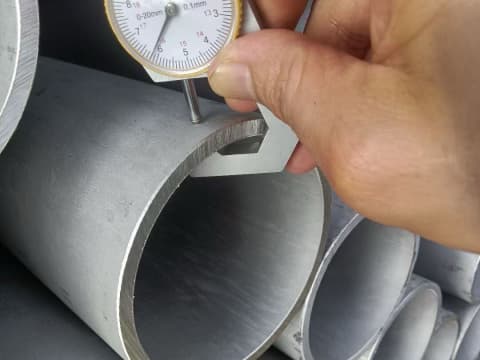
- Values shown are theoretical standard dimensions. Actual steel pipes are subject to ASME‑specified wall‑thickness tolerances which vary across sizes. Always request the Mill Test Report (MTR) before bulk procurement to confirm real‑world parameters.
- This table complies with ASME B36.10M (for welded / seamless wrought carbon‑steel, alloy‑steel and ferritic‑stainless‑steel pipe). For austenitic stainless‑steel pipe, refer to ASME B36.19M, whose wall‑thickness series carry the suffix “S” (e.g. Sch 40S).
- This table only covers the most‑frequently‑used Sch 40 and Sch 80 series. ASME B36.10M also defines Sch 5, 10, 20, 30, 60, 100, 120, 140, 160 plus STD, XS and XXS. Contact us if you require the full dimension table.
3. Four Practical Specification‑Selection Recommendations
- Prioritise outer diameter instead of “inch size” for piping matching. Different standards (such as GB/T, JIS) may define different outer‑diameter values for pipes described as “1‑inch”. However, outer‑diameter values under the ASME system are globally accepted as baseline. For international procurement or export orders, always communicate using outer‑diameter in millimetres, together with clear NPS and Schedule designation, to avoid fit‑failure upon delivery.
- Select wall thickness according to service conditions
- Low‑pressure water/gas service (≤ 1.6 MPa): Sch 40 is sufficient. It delivers lower cost, larger inner bore, and minor flow loss.
- High‑pressure steam / chemical‑media service (≥ 4.0 MPa): Prefer Sch 80 or heavier series (e.g., Sch 160). Sacrifice partial bore size for enhanced safety margin.
- Do not overlook inner‑diameter impact on flow velocity. Take DN 100 (NPS 4) pipe as an example: Sch 40 yields ID 102.26 mm while Sch 80 yields ID 97.18 mm. At an identical flow rate, reduced inner diameter raises flow velocity, which in turn increases pressure‑drop risk and erosion risk. Re‑calculate pump head based on actual inner diameter during design work.
- ⚠️ Avoid legacy STD / XS designations for large‑bore orders. STD (Standard) and XS (Extra‑Strong) are early‑generation wall‑thickness codes. Their equivalence to Sch 40 / Sch 80 only holds for certain size ranges:
- When NPS ≤ 10: STD = Sch 40. When NPS > 10: STD uses fixed wall thickness of 9.53 mm and no longer equals Sch 40.
- When NPS ≤ 8: XS = Sch 80. When NPS > 8: XS uses fixed wall thickness of 12.70 mm and no longer equals Sch 80.
- XXS (Double‑Extra‑Strong) has no corresponding Schedule number.
Procurement Tip
Orders marked only STD or XS for large‑bore pipe may result in pipes thinner than expected, creating pressure‑safety hazards. For large‑bore projects, specify Schedule numbers directly (e.g., Sch 40, Sch 80). Do not rely on legacy STD / XS notation.
4. FAQs
Q: Why is NPS 4 outer‑diameter 114.3 mm rather than 4 inches (101.6 mm)?
A: NPS is a nominal designation and does not represent the actual outer diameter. NPS 4 means nominal 4‑inch size but actual OD equals 4.5 inches (114.3 mm). This comes from historical evolution of ASME standards to maintain backward‑compatibility with legacy fittings. Never compute outer diameter purely from NPS; always refer to official dimension tables.
Q: What does “Sch” stand for in Sch 40 and Sch 80?
A: “Sch” is short for Schedule. It is a wall‑thickness‑series index derived from pressure‑design formulas. Larger Schedule numbers correspond to thicker walls and higher pressure‑bearing capability.
Q: Are STD / XS fully equivalent to Sch 40 / Sch 80?
A: Not across all sizes.
- STD = Sch 40 for NPS 1/8 ~ NPS 10.
- XS = Sch 80 for NPS 1/8 ~ NPS 8.
- Beyond those ranges, STD and XS adopt fixed wall‑thickness values and no longer map to any Schedule number.
For engineering procurement documents, specify Schedule numbers directly to eliminate ambiguity.
Q: Do seamless pipe and welded pipe share identical theoretical OD / ID?
A: Theoretical OD and ID are identical as long as both comply with the same standard such as ASME B36.10M. Nevertheless, welded pipe may carry minor internal weld bead protrusion. Actual flow bore shall be judged by minimum clear passage dimension.
Q: How can I calculate inner diameter for non‑standard custom wall thickness?
A: Use the formula: ID = OD − 2 × WT. Example: OD 168.3 mm, wall thickness 10 mm → ID = 168.3 − 20 = 148.3 mm.

Closing Remarks
Steel‑pipe dimensions act like punctuation marks in engineering language: one mistake can invalidate the whole design. Save this table as your quick‑reference checklist.
Before placing orders, always confirm four key parameters in writing with your supplier: NPS, outer diameter, Schedule wall‑thickness series, and inner diameter.
If you need complete full‑range Schedule dimension tables (covering Sch 5 through Sch 160, STD, XS, XXS), or have specification‑selection questions for your specific project, feel free to contact our online customer‑service team. Our technical engineers will provide professional support promptly.
We supply steel pipes, and we also deliver reliable global‑standard technical dimension support.