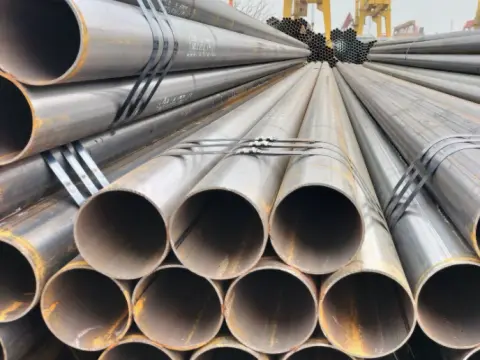
Electric Resistance Welded (ERW) longitudinal pipe and Longitudinal Submerged Arc Welded (LSAW) pipe are the two most widely adopted longitudinal welded steel pipes for oil & gas transmission, steel structures, offshore pile foundations and other pipeline projects. A top question raised frequently is: which pipe delivers higher strength, greater load-bearing capacity and superior safety?
This article compares the two pipe types from manufacturing process, base material, weld strength, pressure resistance, bearing capacity and low-temperature toughness, and provides material selection recommendations to help match pipe grade precisely with engineering requirements.
I. Fundamental Difference
First, the core distinction between ERW and LSAW lies in their diameter and wall thickness production limits:
- ERW: Max outer diameter approx. 610 mm, max wall thickness approx.19 mm. ERW cannot produce pipes beyond this range.
- LSAW: Minimum OD starts at 406.4 mm, up to 1422.4 mm; wall thickness can exceed 32 mm.
Essentially, ERW excels in small & medium diameter pipes, while LSAW is dedicated to large-diameter thick-wall pipes.
Definition of ERW and LSAW
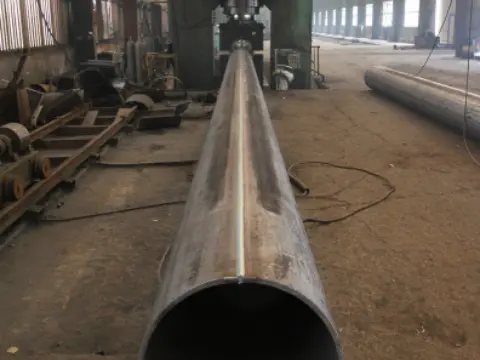
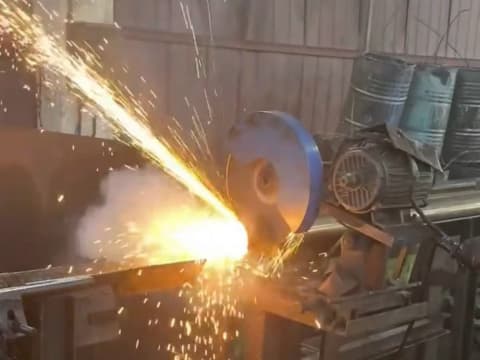
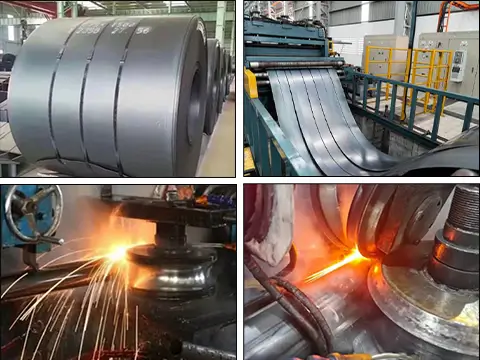
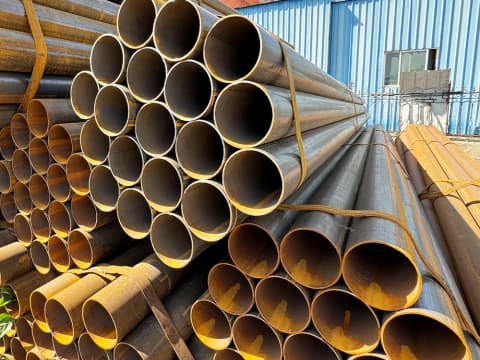
- ERW: Fabricated from hot-rolled steel strips. After cold forming, high-frequency current heats the pipe edges, which are squeezed together to form a straight weld without adding filler metal.
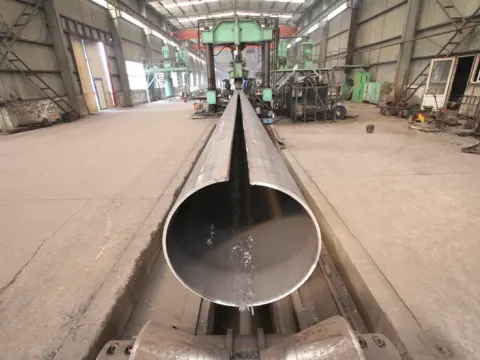
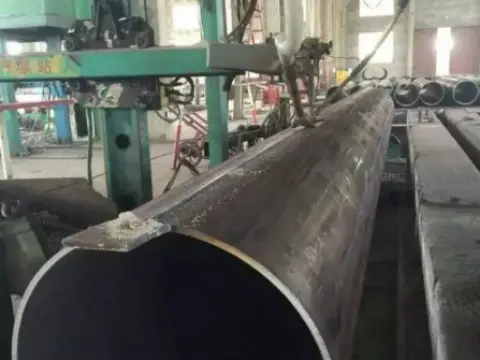
- LSAW (Longitudinal Submerged Arc Welded Pipe): Made from single medium-heavy steel plates. Plates are pressed into tubular profiles, then double-sided submerged arc welded and expanded. Classified by forming method into UOE, JCOE and HME types.
Both are longitudinal welded pipes, yet they differ significantly in raw materials, manufacturing processes and applicable scenarios.
II. Strength Gap Originates Not from Base Material, But from Process & Adaptability
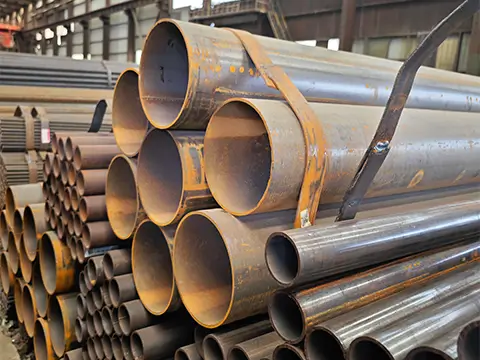
Many mistakenly believe ERW and LSAW adopt different steel grades. In fact, their base materials feature comparable inherent strength, with no obvious difference in yield strength or tensile strength.
The real strength differences show up in four dimensions: weld reliability, wall thickness upper limit, pressure containment limit, fatigue resistance and deformation resistance, elaborated below.
III. Strength Comparison: Which Is Stronger?
There is no universal answer; evaluation must be performed dimension by dimension.
3.1 Pressure Containment Capacity
LSAW presents obvious advantages in pressure resistance.
- LSAW: X70 grade available in wall thickness 6.4–32 mm. Double-sided internal & external welding delivers weld joint efficiency up to 1.0, suitable for high-pressure large-diameter long-distance transmission pipelines.
- ERW (HFW line pipe): Wall thickness range 4.0–19.1 mm, designed for medium & low pressure services.
For large-diameter pipelines with high design pressure, LSAW is recommended for higher safety margin of weld integrity.
3.2 Weld Reliability & Welding Process
| Comparison Item | ERW | LSAW |
|---|---|---|
| Welding Method | High-frequency resistance heating & compression welding; no filler metal added | Double-sided submerged arc welding with welding wire and flux |
| Weld Post-treatment | Weld heat treatment required; internal burr controlled within -0.2~0.5 mm | Pre-welding + finish welding, plus mechanical expanding |
| NDT Requirement | Full-length weld inspection via UT / ET | Full-length weld inspection via RT or UT |
| Weld Joint Efficiency | 0.85–1.00 | 1.00 (under full RT inspection) |
What is weld joint efficiency? It is the strength reduction factor used in pipeline design. A factor of 0.85 means weld strength is calculated at 85% of base metal strength; factor 1.0 indicates weld strength matches base metal.
3.3 Quantitative Comparison of Key Parameters
| Parameter | ERW (API5L X60) | LSAW (API5L X60) |
|---|---|---|
| Max Outer Diameter | 610 mm (24″) | 1422 mm (56″) |
| Max Wall Thickness | 22 mm | 60 mm |
| Burst Pressure at 24″ Max Spec | 2598 psi | 7080 psi |
| Weld Joint Efficiency | 0.85 standard / 1.0 after heat treatment | 1.0 |
| Typical Charpy Impact Energy (-20℃) | 40~60 J | 80~120 J |
| External Collapse Resistance | Low to medium | Medium to high |
IV. Engineering Material Selection Guide: ERW or LSAW?
4.1 Prioritize LSAW for the following scenarios
- Large-diameter long-distance pipelines (≥16″), thick-wall, high-pressure oil & gas trunk transmission pipelines.
- Deepwater, cold, polar and other low-temperature severe service pipelines; high-pressure / high-grade X70, X80 steel with elevated design pressure.
- Offshore wind pile foundations, large steel structural supports, deeply buried heavy-load pipelines.
- Projects requiring larger corrosion allowance, medium transportation with corrosive media, H₂S-containing high-risk service.
- Class 1 and Class 2 pipelines in densely populated urban areas requiring extremely high pipeline safety. Large-diameter high-pressure pipeline projects normally select LSAW (PSL2) for superior weld reliability and safety margin.
4.2 Prioritize ERW for the following scenarios
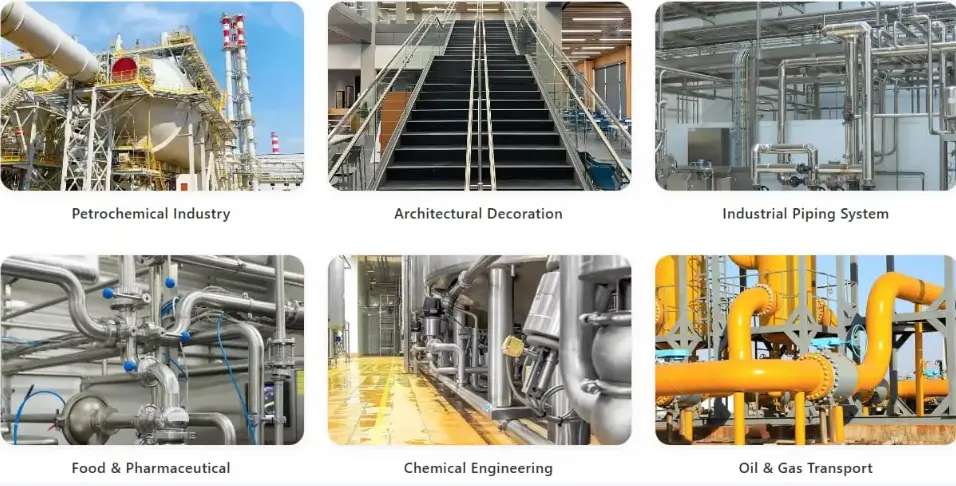
- Small & medium diameter (≤24″), medium-low pressure municipal water supply & drainage, compressed air and gas transmission pipelines.
- General steel structures, supports, guardrails and light structural works.
- Fluid transmission projects under ambient temperature, normal pressure and simple external load conditions.
- Budget-sensitive projects: ERW has lower cost and shorter production lead time than LSAW.
4.3 One-sentence Summary
ERW features economy & high efficiency — the optimal choice for small-medium diameter, medium-low pressure and general applications. LSAW features large size and high reliability — the inevitable selection for large diameter, high pressure, long-distance transmission and harsh working conditions.
VI. Conclusion
If comparing comprehensive performance, LSAW steel pipe outperforms ERW in overall strength, safety and service adaptability, and is the preferred pipe for high-end critical engineering.
For conventional civil engineering, ERW fully meets performance requirements, with excellent cost-effectiveness and high dimensional accuracy, making it the optimal option for engineering cost reduction.
The core principle of pipe selection is to match pipe material accurately according to diameter, wall thickness, pressure and service environment, balancing safety and economy.