Standard Reference: ASME B36.10M for American standard carbon steel pipes (ASTM A106/A53 Grade B, etc.) – wall thickness grade comparison and selection reference under normal temperature conditions.
1. What is the Schedule (SCH) Wall Thickness Grade?
SCH is the designation for wall thickness grades in American standard piping. The larger the number, the thicker the pipe wall.
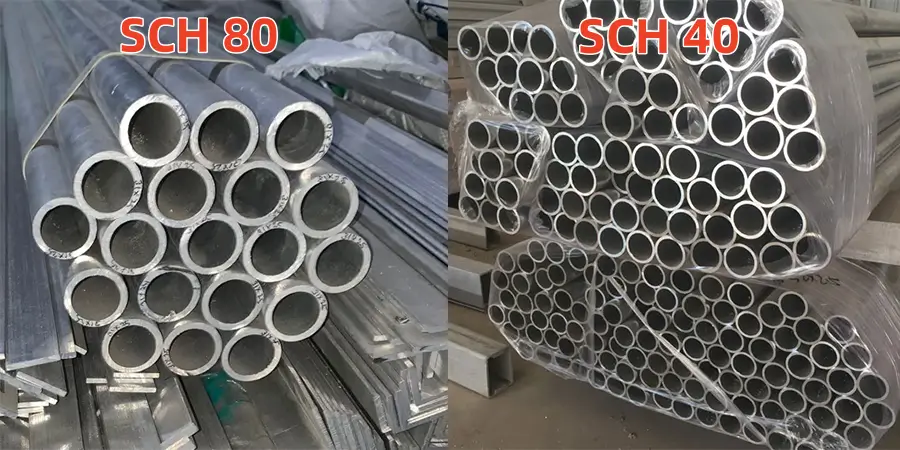
For the same nominal pipe size (NPS), Sch40 and Sch80 pipes have the same outer diameter; only the wall thickness differs.
| Grade | Former Name | Positioning |
|---|---|---|
| Sch40 | STD (Standard Wall) | General-purpose industrial grade |
| Sch80 | XS (Extra Strong) | Used for high-pressure/special conditions |
Important Reminder: The SCH number itself is not a pressure rating; it is merely a wall thickness specification. The actual allowable working pressure is also determined by material, temperature, and welding method. The SCH number cannot be directly used as the design pressure.
2. Core Differences Between Sch40 and Sch80
2.1 Same outer diameter, different wall thickness
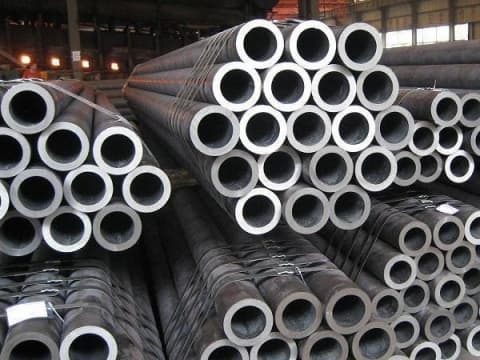
For the same NPS, Sch80 has a significantly thicker wall than Sch40, resulting in a smaller inner diameter and reduced flow cross-section for the medium.
2.2 Different pressure-bearing capacity
Under the same material and normal temperature conditions, the allowable working pressure of Sch80 is 30%–60% higher than that of Sch40. As the pipe size increases, the pressure difference between the two gradually narrows.
2.3 Different corrosion allowance
A thicker wall provides greater corrosion allowance. In buried or corrosive-medium applications, Sch80 offers a longer service life.
2.4 Different wall thickness definition
Sch40 and Sch80 are wall thickness series numbers, not fixed values. Their original calculation formula was related to design pressure (Sch = 1000 × P / S), but today the specific wall thickness is mainly obtained from ASME standard tables.
3. ASME B36.10M Wall Thickness and Reference Pressure
To help you visualize more clearly, here is a typical ASME B36.10M wall thickness table example.
3.1 Wall Thickness Dimensions Summary
| NPS | Outer Diameter (mm) | Sch40 Wall Thickness (mm) | Sch80 Wall Thickness (mm) |
|---|---|---|---|
| 3/4″ | 26.7 | 2.87 | 3.91 |
| 1″ | 33.4 | 2.77 | 3.73 |
| 1-1/2″ | 48.3 | 3.68 | 5.08 |
| 2″ | 60.3 | 3.91 | 5.54 |
| 4″ | 114.3 | 6.02 | 8.56 |
| 6″ | 168.3 | 7.11 | 10.97 |
| 8″ | 219.1 | 8.18 | 12.70 |
| 10″ | 273.0 | 9.27 | 12.70 |
3.2 Reference Pressure Ratings (PSI)
| NPS | Sch40 Reference Pressure (PSI) | Sch80 Reference Pressure (PSI) |
|---|---|---|
| 3/4″ | ~1700 | ~2400 |
| 1″ | 1400 | 1900 |
| 1-1/2″ | ~1200 | ~1700 |
| 2″ | 1000 | 1450 |
| 4″ | 850 | 1200 |
| 6″ | 700 | 1050 |
| 8″ | ~580 | ~900 |
| 10″ | ~500 | ~700 |
As can be seen, for the same NPS, wall thickness increases with the SCH number. However, Sch80 is always higher than Sch40 for the same size.
3.3 Precise Correspondence of Former Names (STD/XS)
| Relationship | Applicable Scope |
|---|---|
| Sch40 = STD | Valid for carbon steel pipes with NPS ≤ 10″ |
| Sch80 = XS | Valid for carbon steel pipes with NPS ≤ 8″ |
Note: When NPS > 8″, the Sch80 wall thickness exceeds that of traditional XS and has its own independent wall thickness value (e.g., 10″ Sch80 = 12.70 mm), and is no longer exactly equivalent to XS.
4. Weight and Cost Comparison
Sch80 is 35%–55% heavier than Sch40 — it is the heavier, thicker-walled version of Sch40.
| Comparison Aspect | Sch40 | Sch80 |
|---|---|---|
| Per-ton unit price | Base | Roughly the same |
| Per-meter unit price | Base | 30%–50% higher |
| Shipping cost | Lower | 35%–55% higher |
| Pipe supports | Standard | Stronger / more closely spaced |
| Fittings | Sch40 grade required | Sch80 grade required |
| Overall cost | Base | Significantly higher than Sch40 |
Conclusion: When design pressure requirements are satisfied, prioritizing Sch40 is key to controlling overall project cost.
5. Application Scenario Comparison: Sch40 vs. Sch80
| Aspect | Sch40 Pipe | Sch80 Pipe |
|---|---|---|
| Operating conditions | Medium/low pressure, moderate temperature, mildly corrosive fluids | High pressure, high temperature, corrosion allowance required, impact / heavy-duty conditions |
| Media | Water, compressed air, fire water, low-pressure steam, general process gases | High-pressure steam, high-pressure gases, hydraulic oil, chemicals, corrosive media |
| Connection method | Large/medium diameters (≥2″) usually welded; small diameters can be threaded | Small diameters (≤1.5″) often threaded, as thicker wall is less weakened by threading |
| Economy | Lower cost, lighter weight | Higher cost, heavier weight |

6. Sizing Recommendations by Pipe Size
6.1 Small-Bore Pipes (≤ 1.5″) – Special Consideration for Threaded Connections
For small sizes such as 3/4″, 1″, and 1-1/2″, Sch80 has a very important application advantage — threaded connections.
- Limitation of Sch40: Small-diameter Sch40 pipes have their wall strength severely reduced after threading, making them prone to fracture at the thread root.
- Advantage of Sch80: The thicker wall (e.g., 3.91 mm for 3/4″) leaves sufficient remaining wall thickness after threading to withstand pressure. Therefore, for instrument lines, hydraulic lines, high-pressure air branch lines, and other applications requiring threaded connections, Sch80 is usually mandatory.
Engineering convention: For NPS ≤ 1.5″, many design institutes default to Sch80 even when the calculated pressure is not high, to ensure the safety and reliability of threaded connections.
6.2 Medium and Large-Bore Pipes – Selection Logic
For sizes 4″, 6″, 8″, 10″ and above, selection mainly depends on design pressure, temperature, and corrosion allowance:
| Pipe Size | Suitable for Sch40 | Suitable for Sch80 |
|---|---|---|
| 4″, 6″ | Design pressure ≤ 800 PSI, no or mild corrosion, normal or moderate temperature | Design pressure > 800 PSI, or corrosive media requiring extra wall thickness, or high-temperature conditions |
| 8″, 10″ | Design pressure ≤ 500–600 PSI, conventional water, air, steam lines | Higher design pressure, or risks of erosion/wear (e.g., fluids containing solid particles) |
7. Common Pitfalls in Selection
- Do not blindly choose Sch80: If Sch40 already meets the system pressure requirements, selecting Sch80 only increases procurement costs and reduces flow capacity, resulting in unnecessary waste.
- Temperature reduces pressure rating: As temperature rises, the allowable stress of steel decreases, and both Sch40 and Sch80 will have lower actual allowable pressures.
- Fittings must match: If the pipe is Sch80, the corresponding elbows, flanges, and tees must also be Sch80 grade; Sch40 fittings cannot be mixed.
- Stainless steel pipes carry an “S” suffix: Sch40S and Sch80S correspond to ASME B36.19M for stainless steel standards.
8. Summary
Sch40 and Sch80 are essentially two wall thickness options under the same outer diameter.
For the vast majority of general industrial applications, Sch40 is sufficient. Only under special conditions is an upgrade to the heavier-wall Sch80 necessary.